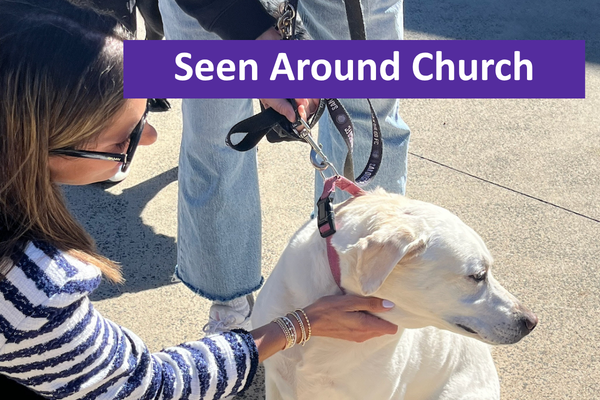

Seen Around Church – Week of August 16, 2026
August 19, 2026
Church Family Moment for Sunday, August 30, 2026
August 25, 2026In John 3:1–8, Nicodemus comes to Jesus at night with honest questions about faith, identity, and what it means to belong to God. Jesus responds not with a simple explanation but with a mystery: “Very truly, I tell you, no one can see the kingdom of God without being born from above.”

In this conversation, Jesus names what Reformed theology has long held at the center of our faith that regeneration is not something we accomplish, but something God does in us by grace through faith and through the work of the Holy Spirit. To be “born again” is the ongoing, life-giving work of God who is continually renewing us, shaping us into the people God calls us to be, and drawing us deeper into Christ. Our faith is not only about believing; it is about being transformed as God continues to shape us and work through us in ways we cannot always see or control.
This is why the Sacrament of Baptism is so central to our identity as Christians. In baptism, God marks us as God’s beloved children long before we are able to articulate belief or fully understand the mystery we are entering. We are named, claimed, and held by God’s grace, and given new life through the waters of baptism. Baptism becomes a living sign that regeneration is not a one-time event, but a lifelong reality as God continually calls us into grace, repentance, belonging, and transformation. In this way, to be born again is to be held by the God who is not finished with us, and who, through the waters of baptism and the ongoing work of the Spirit, forms us into a people of renewal and hope.
As children, youth, and families complete the “Remembrance of Your Baptism” sheet, they are not simply recalling a past event, but remembering who and whose they are, which are beloved children of God. I hope you will take time to recall your baptism and name the people, stories, and moments that root you in God’s faithful love, so that you might see how God has been at work in your life from the beginning and continues, even now, to make all things new.
In the end, Nicodemus does not leave with a formula for faith, but with an invitation to be born again in and through Christ. To be “born again,” as Jesus describes it in John 3:1–8, is to be caught up in the ongoing work of God’s Spirit, who is not finished with us, our church, or our world. Barbara Brown Taylor reminds us in her book titled, Learning to Walk in the Dark that “new life starts in the dark. Whether it is a seed in the ground, a baby in the womb, or Jesus in the tomb, it starts in the dark.” This is what John 3 also teaches us: God’s new life often begins where we cannot yet see it. A seed disappears into the soil before it grows. Jesus is laid in a tomb before resurrection. And so, in seasons of uncertainty, fear, or suffering, when we wonder where God is, John 3 insists that God is still at work. The Spirit is still moving. Christ is still forming new life in us and among us, even now, and in God’s time, it will break forth with resurrection hope.